
Ben Hall Family 1802-1977
The story of Benjamin Hall is the story of an English countryman sentenced to be transported to New South Wales for stealing, assigned in the Colony to a Hunter Valley pastoralist, who served his sentence, married, and raised a large family. One who also established himself as a small farmer but one who was never too nice as to the acquisition of cattle or horses.
The available evidence of his life leaves considerable gaps whuch have been filled with supposition. The suppositions are, it is hoped, in general accurate though they may well be inaccurate in detail. A difficulty in his story is the number of legends that have grown up as to Benjamin Hall and his family, which while containing and element of truth have often so embellished the fact, that the resultant story is inaccurate.
There is no information as to his parents or their situation in life. His precise birthday is unknown. As to his age, from his marriage Certificate he would appear to have been born in 1802. His Convict invoice could give his birth year as 1804 unless it refers to his age when sentenced which would give 1802. His death certificate could give 1801.
The fact that he could read and write and that when he bought land in New South Wales he described himself as a yeoman may indicate that his parents were of that class in England.
His birthplace is not recorded but again from the Convict invoice it would appear to be in or near Bristol.
On the same invoice his occupation is described as that of a groom
. An account written by one of his grandsons states that he was a farm labourer.
From the knowledge of horses which he displayed in New South Wales and from his ability as a farmer it would seem that the description on the invoice is the more accurate.
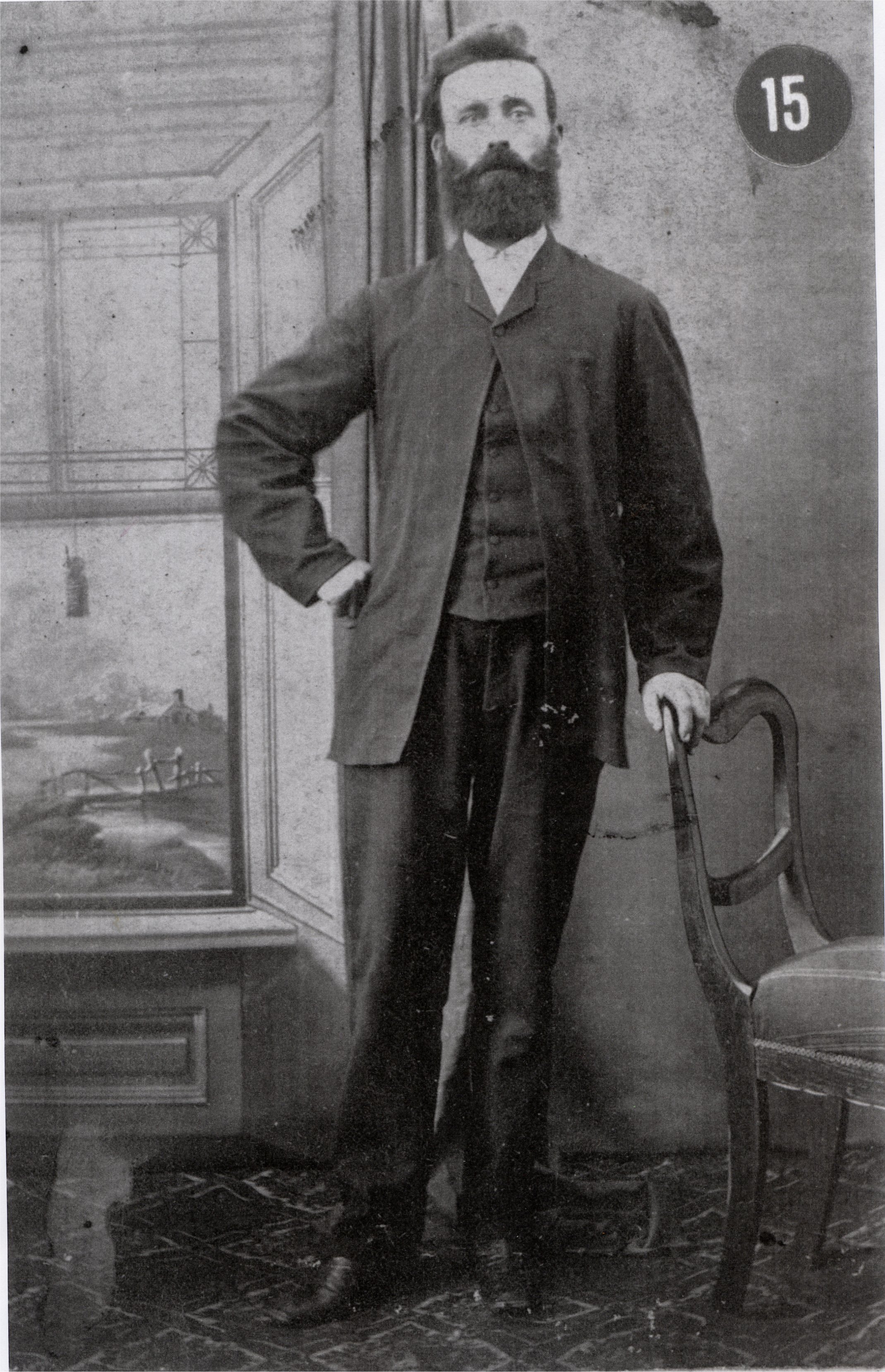 It was in 1825 that he fell foul of the law when he, Samuel Snappell aged 18, Ellen Wayland aged 16 and Sarah Jones aged 18 were all brought before the Bristol Quarter Sessions on charges of stealing. The charges related to stealing clothes to a value exceeding one shilling. Unfortunately the circumstances of the case are not available. It is noted that Benjamin (right) had on his right arm the letters S.J. presumably tattooed. This raises the possibility that Sarah Jones may then have been his girlfriend.
While both Benjamin and Snappell were convicted the two girls were acquitted. The Court hearing took place on 11th July, 1825.
Benjamin was sentenced to be transported for seven years.
After conviction he was either immediately or later marched to Portsmouth where he was placed on a prison hulk to transport him to New South Wales.
In those days conditions in English prisons were bad and conditions on the hulks little better. They could be described shortly as crude, cruel and unsanitary.
After about a year he was placed on a transport, the Midas (430dwt), for the journey to New South Wales. The Midas was not a regular transport and would have been specially fitted out to carry convicts.
They would have been placed in the holds in which tiers of wooden bunks would have been built or fittings for slinging hammocks arranged. They would live in the holds, eat there, with most primitive sanitary arrangements and allowed on deck only at specified times in good to moderate weather. In bad weather the hatches of the holds would be covered and ventilation minimal. On the other hand the ship did carry a surgeon whose function was to look after the health of the convicts.
Food was supplied according to a Government regulation issue which while adequate was minimal and often the quality of the rations and their preparation left much to be desired. The issue of fresh water was sufficient for drinking only, all washing whether of clothes or bodies was done using salt water baled from the ocean. Altogether while conditions were harsh and primitive, they were probably better than those obtaining on the hulk.
The Midas sailed on 16th October, 1826 from Portsmouth with about 151 convicts on board and arrived in Port Jackson on February, 15 or 16, 1827, quite a reasonable time for the voyage in those days. They probably called at no port en route. Three convicts died during the voyage.
On arrival she probably anchored in Sydney Cove but no convict would be disembarked until indents for each man were made out. This was done with reasonable expedition and the convicts would then have been put ashore and marched to the convict barracks (Hyde Park Barracks which still stand). Shortly after arrival there, the convicts would be offered as assigned servants for the duration of their sentence to private individuals or allocated to government work gangs.
Benjamin’s invoice is dated Feburary 18, 1827, so he probably arrived at the Barracks that day or the next. His invoice describes him as being 5 feet 6 inches in height (about 169cm) of sallow complexion, hair dark brown, eyes grey, S.J. on right arm, large scar across the back of left hand, two cuts on head over left ear.
Being a groom by occupation and most applicants for assigned servants being pastoralists he was probably eagerly sought. After about two days he was assigned to Alexander Brodie Sparke as a servant to work on Mr Sparke’s Patrick Plains property called Radfordslea which was worked by a manager for Mr Sparke.
Then, there being no road between Sydney and the Hunter Valley, the normal mode of travel was by sailing packets to Newcastle and Green Hills (now Morpeth). These packets were cutters or small schooners. If wind was favourable they could reach Green Hills in two days from Sydney but if adverse the time was much greater. Being small, if winds were adverse for the trip up the Hunter River to Green Hills, they could be rowed using sweeps.
Benjamin and other convicts travelled to Green Hills in one of these packets probably escorted by a soldier. They would have travelled on deck or in the hold and if it were necessary to row they would have been required to assist.
It is not known how long the trip to Green Hills took, but probably it was two or three days.
On arrival at Green Hills Benjamin and his fellow convicts would have marched to the convict barrack at East Maitland — a little over an hours march.
At the barrack he would have been given directions as to how to get to Radfordslea and rations for the journey of about two days and then sent off to walk there, about 30 miles.
Radfordslea was a 2000 acre undeveloped property managed by an overseer. It is noted that the postal address of Radfordslea was Castle Forbes the property of the notorious Major Mudie. lt was also not far from the ford of the Hunter River near Ben Singleton's Inn.
There were 13 other assigned servants at Radfordslea who under the overseer performed all work necessary for the operation of the property. All were accommodated in rough huts and provided with food and clothing according to a government ration and supply scale. Each was responsible for preparing his own rations which while adequate were often of poor quality. Each was required to work from daylight to dark except on Sundays which was a rest day though if the overseer thought it necessary each could be required to work on that day also. No payment was made for the work except for work on Sunday which if voluntary was ordinarily paid for by the master. Occasionally also convicts were paid for work done outside their normal duties.
Practically no information exists as to Benjamin’s activities while at Radfordslea. He does appear in the 1828 census as a general servant but his age appears wrongly stated. By the end of July 1830 he would have been eligible, assuming he was of good behaviour, for a ticket of leave which would have allowed him to leave Radfordslea and work for anyone, who would pay him wages, in the district; but there exists no record of him ever obtaining such a document. Possibly the harsh attitude of pastoralists in Patrick Plains area towards their assigned servants may have been the reason.
Back to the contents