
Ben Hall Family 1802-1977
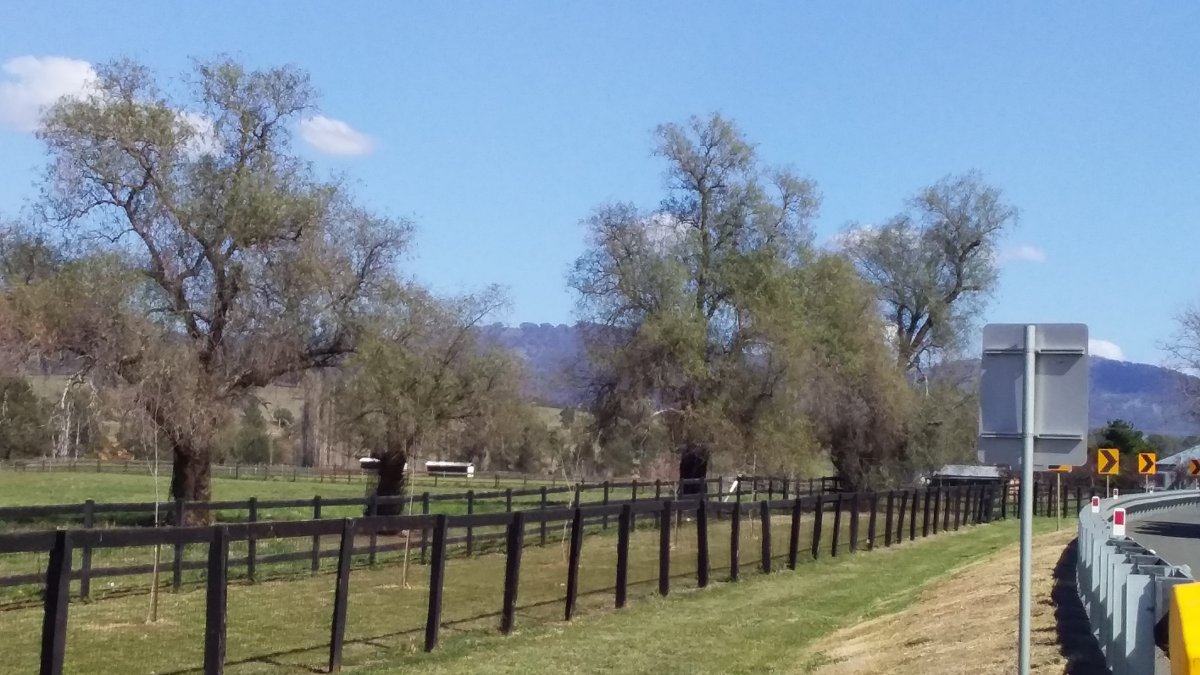
Benjamin was immediately interested in the farms and bought Farm No. 1 situated on the south side of the Great North Road extending to Page's River and bounded on the east by Pentlands part of which had already been subdivided.
The area of the farm was 14 acres all being arable land. The price was £10 per acre (equivalent to about $2000 an acre nowadays). He paid cash for the land which was conveyed to him on November 11, 1854.
As soon as he agreed to buy Benjamin set about erecting a residence on the land, digging a well and establishing crops. The farm was too small to run more than a few much cows and riding horses but it was close to a considerable area of unallotted land (part later becoming Blandford common) where he could readily obtain agistment for his cattle and horses.
It seems that immediately he settled on the purchase and before the conveyance to him he decided to sell his Haydonton property. He placed that sale in the hands of Bernard Keenan (who was also the agent selling Mr. Warland's farms and village allotments). The property was offered for sale on July 31.
If it was sold then and the sale price of £297 looks very like a price offered at auction it was not conveyed to the purchaser until October 1, 1855. It is also notable that when the deeds of the Blandford farm were obtained they were handed to Eliza.
It is therefore likely that Eliza objected to the move to Blandford only a matter of 3½ miles along a well used road and one with, in those days, two public houses between the farm and Haydonton. Quite possibly she only agreed to move if first the house on the farm was completed before she moved and thereafter she would hold the title deeds so that no future move could take place without her agreement.
It is likely that the Hall family moved to Blandford in August or September, 1855.
It also appears that in addition to farming and raising livestock for sale Benjamin operated a small butchery at the farm for some time but ceased before 1857 Possibly this butchery was closed as he does not appear to have ever obtained a slaughterhouse licence from the Murrurundi Court.
Benjamin appeared at Murrurundi Court for the last time as a defendant on July 31, 1854, when he was convicted of using obscene language in a public place. On 17th October he was a successful plaintiff suing James Hussey a butcher of Murrurundi for the price of a bull sold for 25/-. He also commenced proceedings against one R. Williams for ill treatment of a mare of Benjamin on May 17, 1855.
Towards the end of 1856 it seems that Benjamin decided to sell out and leave Murrurundi as on February 5, 1857 he advertised his farm ‘for sales’ . Possibly this decision may have been taken because of the growing rift between Benjamin and his son Edward with whom both Robert and Henry appear to have sided.
He had apparently not consulted his wife as she countered the advertisement by one stating that she held the deeds and she was not moving. The advertisement was probably written for her by Henry and it is notable that instead of using Eliza as her christian name appears on many records she used Elizabeth (or perhaps Henry did for her). Also the farm was called Rosehill which name was for many years later, that of a farm on the south of the Page's River. However it happened there was no sale and Benjamin and Eliza continued to live on the farm. Edward however, from 1857 onwards appears to have frequently been in trouble with the Police chiefly in regard to livestock. On 3rd February, 1859 he married Honorah Kennedy the daughter of a local stockman. The marriage took place at St. Joseph's and it is doubtful whether either Benjamin or Eliza attended as the witnesses appear to have been friends of the brides.
By 1858 Benjamin had begun to outlive his earlier reputation for lifting livestock and he was accepted as a supporting landholder to Benjamin Pathick's application to take over the licence of the Plough Inn at Blandford.
Relations with Edward grew worse, Benjamin accusing him of taking his cattle. They became so strained that on May 3, 1860 Benjamin advertised in the newspaper a warning against buying any livestock bearing certain brands from Edward. This made matters worse — Edward assaulted Benjamin who replied by issuing a summons for the assault against him. Unfortunately there is no record of what happened but from this time Benjamin and Edward went their separate ways.
During 1860 Benjamin was reasonably prosperous. It is noted that he contributed to Maitland Flood Relief Fund of that year. By that year both Robert and Henry, who appear to have been living with their father, were taking employment off the farm often in association with Edward which brought both into disfavour with the local Police as well as with their father. Both Catherine and Ellen were at home assisting in the management of both farm and house.
When the Free Selection Act was passed in 1861 Edward immediately took up a selection on Chilcott's Creek and established his home there but Robert and Henry who had become a notable horseman remained at Blandford.
As he became older Benjamin concentrated more on farming than on raising livestock and it appears that he kept most of his 14 acres under crops .
Late in 1864 Catherine left as she married Joseph Downing Woods a wheelwright of Haydonton who also had a small farm on Pentlands quite close to Benjamin's. Mr Woods was considerably older than Catherine who appears to have put her age back when marrying. The ceremony was conducted by Rev. James Hay, a Congregational minister who was then conducting the Presbyterian church in Murrurundi. The wedding appears to have been a private one as it was celebrated in a house in Murrurundi and again neither Benjamin nor Eliza were present. The wedding took place on December 8, 1864, and Catherine and her husband took up residence in Haydonton.
However within a year it appears that Catherine's husband began to assist Benjamin in the working of his farm as it appears that both Robert and Henry were employed elsewhere though in the Murrurundi district.
On August 29, 1866 Henry married Elizabeth Rideout whose mother resided in a cottage on the banks of Page's River near the ford on the Great North Road which was then called Pethick's Crossing about 500m. from Benjamin's farm. After marriage he and his wife lived in a cottage on Glenalvon. It seems that this marriage was approved by Benjamin and Eliza. Benjamin and Eliza were now living quietly on the farm with Ellen and from time to time Robert and this continued until Eliza's death which occurred on August 16, 1869. The cause of death is not known. She was buried in St. Joseph's churchyard and her grave is marked by a simple headstone on which her christian name appears as Elizabeth. Her death certificate the information for which was supplied by Catherine shows her christian name as Eliza. It also shows that she had in all 11 children of whom five males and three females were living. Of the deceased children one of whom was Benjamin junior it would appear that the others died in infancy either between 1838 and 1842 or between 1842 and 1845.
After Eliza's death Catherine with her husband and family moved into Benjamin's house on the farm and managed the household while Ellen assisted Benjamin on the farm as did Robert from time to time. It is doubtful whether Catherine's husband assisted as relations between him and Benjamin were never good.
In 1870 Robert married Ann O'Neill and set up his home in Murrurundi. At this time Benjamin's relations with Robert and particularly Henry were good.
On February 15, 1871 Benjamin made his will which was drawn up by Mr J.P. Abbott, solicitor of Murrurundi the eldest son of the J.K. Abbott from whom the horses were stolen in 1845. By his will he divided his property particularly the farm between his daughters Catherine and Ellen and his sons Robert and Henry — Catherine received the largest share.
The firmness and clarity of his signature in a petition taken up in July, 1871 indicates that his health was then good . Unfortunately later in that year he was severely afflicted by gout. Yet in 1872 he also signed a petition asking that a Post Office be established at Blandford.
During 1872 Ellen decided to marry a Warrah stockman Daniel Meehan and Benjamin agreed to give her four acres of his farm on which she and her proposed husband could erect their residence. As soon as the dwelling was built Ellen and Daniel married on 30th June, 1873.
Robert. whose wife had died, returned to the Blandford farm in 1873.
Since 1872 Benjamin's health had steadily deteriorated and by the end of 1873 the farm appears to have been run by Catherine and Ellen or their husbands. Robert does not appear to have taken an active part.
At this time Benjamin was so crippled by gout as to be partly bedridden.
It would appear that Catherine and Ellen combined to get Benjamin to alter his will. A codicil was prepared whereby the land given in the will to Robert and Henry was given to Catherine. The codicil was signed on 10th July, 1874 in the presence of William Doyle and Michael Heiler adjoining farmers .
Not long afterwards Benjamin's condition worsened — possibly he suffered a stroke. His daughters were unable to look after him. While he could have been placed in Murrurundi hospital he would have had to pay for his accommodation as he was a landowner. If he was confused also it would have been possible that his affairs might have been taken over by the Master in Lunacy and if that occurred his daughters feared that they might lose the farm. Also both Robert and Henry may have queried why the codicil was made.
It appears that Catherine's husband suggested that he might be admitted to the old men's home at Liverpool which accepted indigent ex-convicts. Benjamin of course was not in that category but if he was brought down as an indigent person it would be unlikely that the authority running the home would discover the truth.
It is likely that he was conveyed to Liverpool in the manner reported namely in a litter placed in a dray driven by his son-in-law even though such a journey would have taken a fortnight and it is likely that neither Robert nor Henry knew of his conveyance until he was admitted and the son-in-law returned to Blandford.
Had he been taken down by normal transport which in those days would have been rail to Newcastle, ship to Sydney, and rail to Liverpool he probably would not have been admitted.
Back to the contents