
There was
|
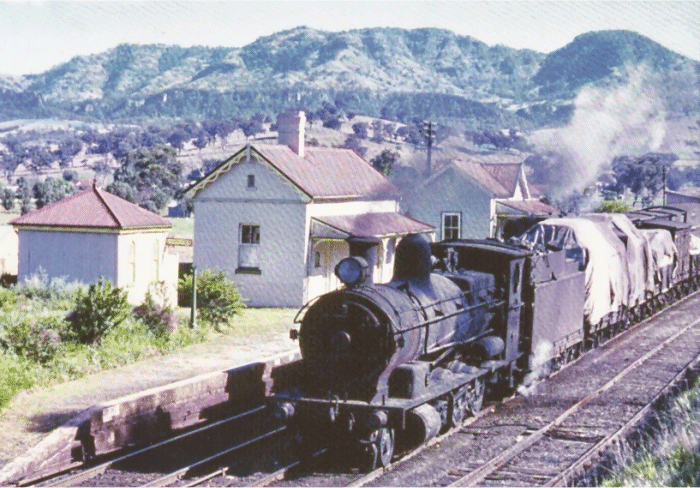
Wingen … in the days when there was a stationThe wonderously
|
The line of Wingen is exactly 1000 feet above sea level, and in the next four miles and three-quarters, which it takes to reach the top of Warland's Range, it rises 400 feet more, afterwards sinking 50 feet in a somewhat easier country along the valley of the Page (river), gradually rising again till it ends at Murrurundi, 1544 feet higher than the Pacific Ocean. In going through Warland's Range there are no less than 21 cuttings (Nos. 19 to 40), aggregating 320,000 cubic yards, the largest cutting amounting to 151,000 cubic yards alone; cuttings and embankments nearly corresponding in length, the first being; 181 chains, and the last 191; while the tallest embankment is 45 feet, and the deepest cutting 34 feet. The road and the rail cross each other about midway, and near the intersection is another heavy embankment 42 feet high; but, as a rule, the work is not so severe after leaving Warland's Range behind; for, though the lengths of both are more, the cubic contents are less, there being 380 chains of embankment and 460 chains of cutting, of which the cubic contents represent 246,000 yards (320,000 by 146,000 equal to 566,000). |
Line of Wingen |
There are six sub-contracts for earthwork on this extension, ballasting and laying the permanent-way being another, the whole being the subject of one general contract in the name of Mr Macquarie. Iron is supplied by the Government, and excellent ballast in any quantity from the bed of the Page. The sleepers appear to be laid three feet, centre to centre on parallel baulks, which, when the rails are laid and ballasted up, are drawn and pushed on ahead to repeat the process. The culverts range from 3 to 10 feet, well finished in brick and cement, with freestone facings, but the two creeks that pass under this portion of the line are spanned by timber bridges, viz., Campbell's Creek, one mile and a half from Murrurundi, with a bridge of ten openings, and Murulla Creek, three miles and a half from the same romantic place, with a bridge of six openings. The permanent way is now laid three miles beyond Wingen, and is progressing favourably; the cuttings will be completed in a month, and there seems reason to believe that the line will be ready for traffic to Murrurundi by March next. There will be no further passenger accommodation at Wingen (station pictured above in the mid 1950s and since demolished) than there is at present (which is limited), but a platform will most likely be established at Blandford for the convenience of the influential squatters and residents there; the Murrurundi Station, however, will probably be the terminus for some time to come, the Liverpool Range (for one reason) barring the way to the north, and making it doubtful for reasons both engineering and in the way of traffic, whether the line should continue north or veer to the-west. |
Campbell's Creek |
The terminus, pro tem., will be similar to that at Scone, as far as the principal buildings are concerned and will consist of a passenger station, in brick 70 feet long, with a platform of 200 feet, a goods-shed 120 feet, an engine-shed 107 feet, a wool platform 80 feet long, besides a carriage-dock, pumping tank, and turntable for reversing engine and tender together. At this station also there will be two lines of rails, six engine-pits, and engine-fitter's store; the buildings dedicated to the secondary purposes of goods and machinery, standing on piles, framed in hardwood, and roofed with galvanized iron; while the passenger-station will have freestone dressings, with a roof of slate. The water supply will be obtained by steam from a well in the bed of the Page (River). |
The Terminus |
There two items, the pump and turntable, are not included in the estimate of cost, which is between 5000 pounds and 6000 pounds. Messrs Stephens and Smith, the contractors, are actively engaged in levelling and preparing for the various buildings, which will necessarily cover a considerable area of ground. The timber is mostly brought from Sydney, as the local hardwood is either useless or inaccessible. In circumventing Mount Murulla, the river and the rail perform a Quarter circle, for the direction of the railway, which is north at Wingen, turns west at Murrurundi; Mount Murulla, surrounded by its spurs and offshoots, standing as a centre from which the arc was struck. This is the most attractively picturesque (but not the grandest) bit of railway scenery in the colony, for the happy conjunction of mountain and valley presented by the railway following the course of the river, will, when opened, afford glimpses of lofty and varied hilltops, intermingled with green and cultivated level land spreading away from the river banks, that cannot fail to gratify the taste of any admirer of natural beauty. | £6000 cost |
W. B. Wadem Esq., who rode with me along the, as yet, incomplete line, is the engineer, while G. Cowdery, Esq., is engineer for the contractors, their manager being Mr A. Kerr. The offices, stores, houses, huts, and stables form quite an extensive township at Wingen, for the number of men employed is 412, and the horses muster 158.
| |
Name: Town and Country Journal | Editor: Supplied by T. A. Sevil of Willow Tree |
Date: October 28, 1871 |